


Retirement Planning Tips Every MOSERS Member Should Know
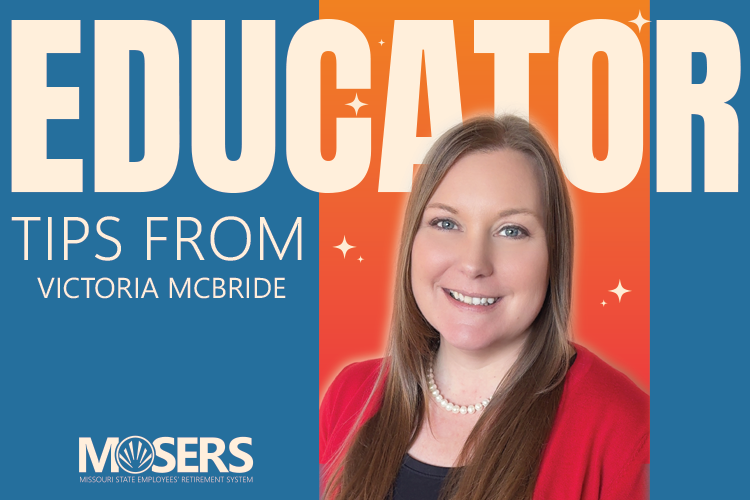
MOSERS educator Victoria McBride shares her retirement planning tips and explains why understanding your benefits doesn’t have to be complicated.
Before joining MOSERS as an educator, I spent several years serving the state of Missouri with the Department of Corrections in a variety of roles, including probation & parole officer, criminal investigator, and training officer. Those roles taught me a lot about communication, problem-solving, and navigating complex systems. What they did not teach me was how to confidently understand retirement planning, pension formulas, employee contributions, or about the deductions coming out of my paycheck.
Like many employees early in their careers, I was focused on learning my profession, building my skills, and simply doing my job well. Retirement felt like something far away—something “future me” could figure out later.
That experience is why I’m so passionate about benefit education today. I know firsthand what it feels like to be knowledgeable and hardworking, yet still completely confused by retirement terminology. So, here are a few tips I wish I had known earlier in my career.
When you first start state employment, retirement can feel like a topic reserved for people who own file folders labeled “Estate Planning” and say things like, “Let’s discuss asset allocation.” That was not me. I was focused on doing my job well, learning policies, memorizing state statutes, and becoming competent in my field.
One of the most valuable things you can do as a state employee is to understand your benefits early—even if retirement feels decades away. The earlier you understand how your plan works, the more informed your future decisions can be. You don’t need to become an expert overnight. You just need to know enough to plan for the future successfully.
Early in my career, I understood salary. Salary made sense. What I didn’t fully understand was that my pension and other benefits were also a major part of my overall compensation package. It’s easy to focus only on what you take home today and overlook the benefits that create long-term financial value. A pension is one of those benefits many people don’t fully appreciate until much later.
Think of it this way: your paycheck is important, but your long-term benefits are also part of what you earn through your service. Basically, your compensation is doing more for you than you may realize.
One of the most common areas of confusion I see is around retirement savings, pensions, and contributions. Many employees see deductions from their paycheck and understandably think, “Great, retirement things are happening.”
It’s important to understand that your MOSERS pension and MO Deferred Comp savings plan are separate benefits that provide two distinct sources of income in retirement. They work together to provide you with financial stability throughout your retirement.
Understanding the difference between your MOSERS defined benefit pension and your defined contribution savings plan through MO Deferred Comp can help you make better-informed decisions throughout your career.
At one point in my career, I left state employment for the nonprofit sector. While the work was meaningful, there were no retirement benefits. Career decisions are deeply personal, and every person’s situation is different. Sometimes changing roles or sectors is absolutely the right move.
Looking back, had I better understood my long-term benefits at the time, I may have evaluated that decision differently. When considering career moves, it helps to ask not only “What am I gaining?” but also “What am I potentially walking away from?”
This does not mean people should never leave state employment. It simply means benefits are part of the full picture and deserve a seat at the decision-making table.
Please don’t wait until retirement is on the horizon to start learning about your benefits. Retirement planning tends to feel much less stressful when it happens gradually instead of all at once. No one is born knowing how pension systems work. If you feel confused, congratulations—you are having a very normal human experience.
That’s why we encourage you to attend a Newer Employees & MOSERS, Mid-Career, or Ready to Retire seminar or webinar based on where you are in your career. You can log in to myMOSERS, check out the MOSERS website, or ask your friendly MOSERS educator a question next time you see us at a conference. As an educator, one of my favorite parts of the job is meeting state employees at our seminars and events!
My goal as a MOSERS educator is simple: to make retirement information understandable, practical, and maybe even interesting. You should not need a finance degree, a color-coded spreadsheet, or an emotional support calculator to understand the benefits that can significantly impact your future.
The truth is, retirement is not a mystery you solve at the end of your career. It’s something you quietly build in the background while you’re busy living your life, doing your job, and trying to remember why you walked into the kitchen. Just step-by-step, year-by-year, in a way that actually makes sense.